
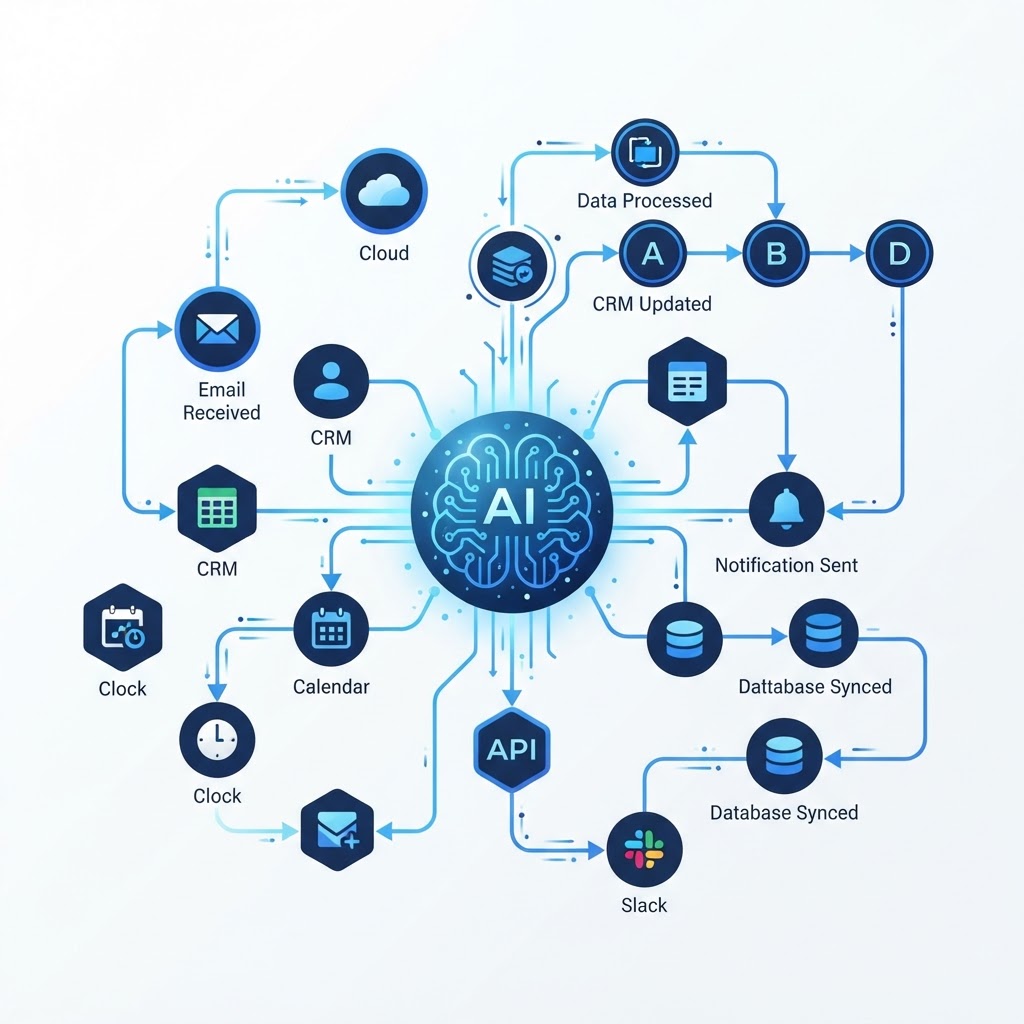
AI automation fails most often not because the technology can't do the job, but because the workflow chosen for it wasn't a good fit. The first automation you build sets the tone for whether AI becomes a trusted tool or a cautionary tale in your organization.
The three qualities of a good first automation
A workflow that's a good candidate for AI automation has three qualities: it's repeatable, it's rules-based, and it's recoverable. Repeatable means it happens often enough to justify the build. Rules-based means the steps can be written down, even if people execute them inconsistently. Recoverable means a wrong output can be caught and corrected before it causes harm.
Where to look in your business
The best candidates hide in plain sight: the tasks people complain about, the ones that eat the first hour of every day, the ones where a mistake is annoying but not dangerous. Inbound triage, recurring report drafting, document summarization, data entry from structured forms. None of these are glamorous, which is exactly why they're good first automations.
- Triage: routing inbound requests, emails, or tickets to the right place.
- Drafting: generating a first version of a recurring report or response.
- Summarizing: condensing long documents into a standard format.
- Extracting: pulling structured data from forms, invoices, or contracts.
What to avoid for the first automation
Avoid high-stakes, one-off, or tightly coupled workflows for your first AI automation. A wrong output in a customer-facing or compliance-critical process erodes trust in AI before it's earned. Start where a mistake is caught by a reviewer, not by a customer.
- Anything customer-facing where the output goes out without review.
- Compliance or legal decisions with no human checkpoint.
- One-off tasks that won't recur enough to measure improvement.
- Workflows tightly coupled to a core system where an error cascades.
Keep a human in the loop
For the first version of any AI automation, route every output through a person who approves, edits, or rejects it. This protects against the non-deterministic failures that AI is prone to and gives you labeled corrections that improve the system over time. The goal of the first automation is to build trust and data, not to remove a person.
Measure before and after
Record the baseline before the automation: hours per week, turnaround time, error rate. After launch, measure the same metrics. Without a before-and-after comparison, you can't tell whether the automation helped, and you'll have no evidence to justify expanding AI to other workflows. The measurement is the automation's business case.
Scale what works, cut what doesn't
Once the first automation is running and measured, the decision is data-driven: if it saved real time and the quality held up, scope the next workflow. If it didn't, understand why before automating anything else. AI automation is cumulative — each successful one makes the next one easier to justify and faster to build, because the patterns and infrastructure are already in place.