
The tech stack you choose for a SaaS MVP is a decision you live with for years, and most founders make it for the wrong reasons — familiarity, hype, or what the first hire happened to know. The right frame is to optimize the MVP stack for two things: how fast you can reach a working product, and how cheaply you can change direction when the market tells you something you didn't expect.
Optimize for change, not for scale
An MVP is a bet on a hypothesis, and the stack should make it cheap to change the bet. A stack that 'scales to millions of users' but takes three months to add a field is the wrong stack for an MVP, because the thing that kills most SaaS products isn't traffic — it's building the wrong thing and not being able to pivot fast enough. Choose for iteration speed first; you can replace components that don't scale when the product actually needs to.
The three layers, decided separately
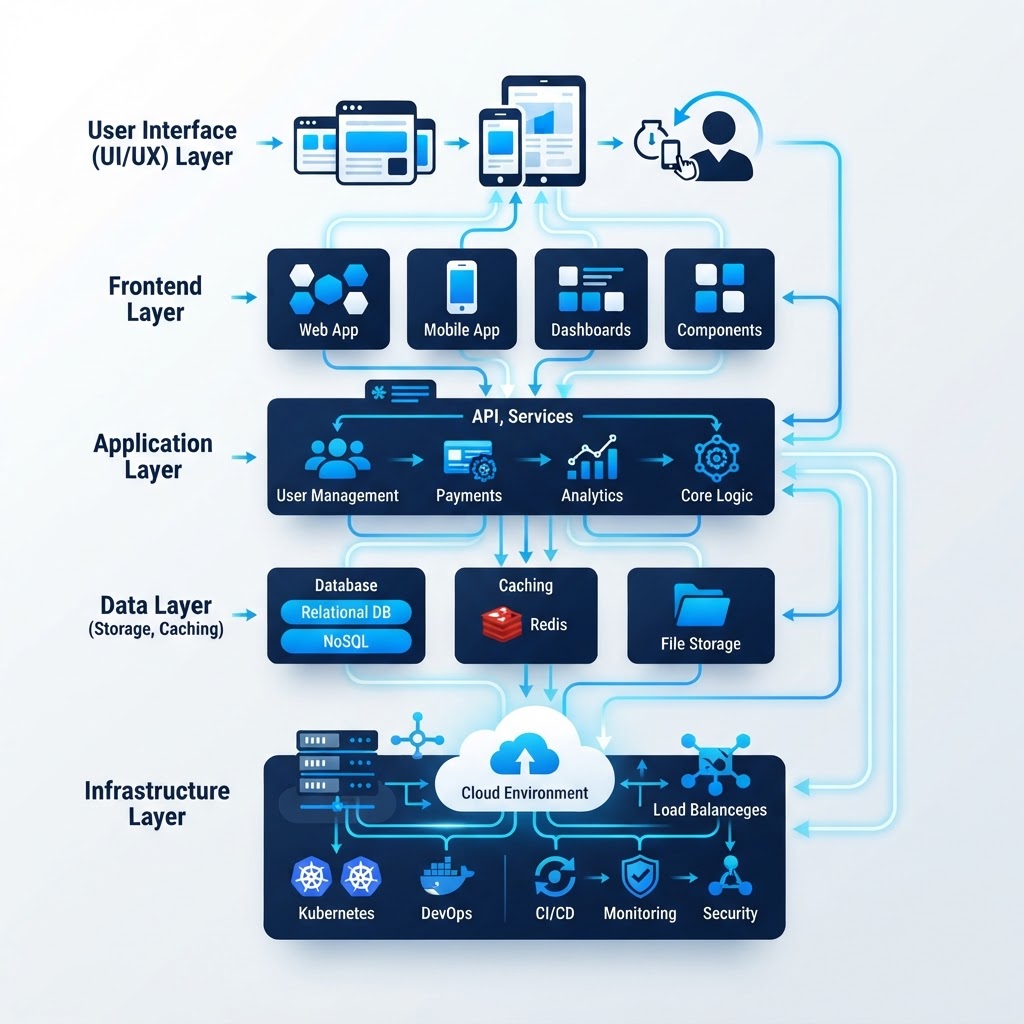
A SaaS stack has three layers, and each can be chosen on its own: the frontend, the backend/API, and the data layer. The temptation is to pick a 'full-stack framework' that couples all three. That's fine for speed, but it means you inherit the framework's opinion on every layer. For an MVP, a coupled framework is often the right call; for a product that expects to outgrow its MVP, a more decoupled choice buys flexibility.
- Frontend: a component-based framework (React, Vue) with a UI library so you don't hand-build buttons.
- Backend: a managed backend-as-a-service for speed, or a lightweight framework if you need custom logic.
- Data: start with a managed database; defer cache, search, and analytics until the product earns them.
Build vs. buy on the boring parts
Auth, payments, email, file storage, and search are solved problems. For an MVP, buy every one of them from a managed provider. The only reason to build any of these yourself is a hard requirement that no provider meets — and that's rare. Every hour spent on auth is an hour not spent on the thing the customer is paying for.
The hiring reality
A stack is also a hiring decision. The most productive stack for an MVP is the one the team — or the first hire — already knows well. A 'better' stack that the team has to learn slows the MVP by the learning curve. If you expect to hire a team, a mainstream stack (React + Node, React + Python, or a popular framework) has a deeper hiring pool than a niche one.
- Mainstream stacks (React, Node, Python) have the largest pool of available developers.
- A niche stack narrows hiring and raises the cost of each hire.
- The stack the founding team already knows is usually the right MVP stack.
What to defer until after the MVP
Defer the parts of the architecture that the MVP doesn't need yet: microservices, multi-region replication, a dedicated search engine, a separate analytics warehouse, Kubernetes. These solve problems the MVP doesn't have, and they add operational cost before the product has proven it deserves the complexity. Add them when the product earns them — not before.
- Microservices: start monolithic; split only when a component has a real scaling or deploy reason.
- Search: a database's built-in search is enough until query volume or relevance demands more.
- Analytics: a managed analytics provider beats standing up a warehouse for the MVP.
- Infrastructure automation: managed platforms remove the need to manage servers at all in the MVP stage.
The decision in one sentence
Pick the stack the team knows best, buy the boring parts from managed providers, defer anything that solves a problem the MVP doesn't have yet, and treat every choice as reversible until traffic or product fit tells you which one isn't.